


Why does the weld become discoloured when anodised?
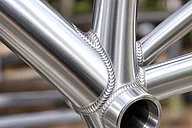
Because the anodic layer grows out of the metal itself, and its alloying elements determine the colour. If the weld metal has a different composition from the base metal, the weld shows up clearly after anodising.
- Silicon colours grey to black, the more strongly the more silicon there is in the weld metal. EN 1011-4 states that AlSi fillers do not give a good colour match with wrought alloys. Welds made with AlSi5 turn dark to black after anodising.
- Chromium gives a yellowish to golden tint.
- Manganese discolours, in our experience, slightly yellowish; the ASM Specialty Handbook Aluminum describes a faint grey instead.
- Magnesium and pure aluminium anodise light and match most wrought alloys best.
Even with a suitable filler, the heat-affected zone can show up, because the heat of welding has changed the microstructure there. For colour-critical parts, therefore, always weld a test piece and anodise it using the same process.
Video (in German): what to bear in mind when anodising welded parts.
Which filler metal is suitable for anodised components?
One whose composition is as close as possible to that of the base metal. AlMg and pure aluminium fillers are particularly suitable for anodising; AlSi fillers are not.
| Base metal | Filler for a good colour match |
|---|---|
| Pure aluminium, AlMn1, AlMg1 | MA-1070 Al99,7 or MA-1450 Al99,5Ti |
| AlMg2,5, AlMg3 | MA-5754 AlMg3 |
| AlMg4,5Mn, AlMg3Mn, AlMg5 | MA-5183 AlMg4,5Mn0,7 or MA-5556 AlMg5Mn |
| AlMgSi (e.g. 6060, 6063, 6082) | MA-5356 AlMg5Cr or MA-5556 AlMg5Mn, not AlSi5; see the trade-off below |
| AlSi casting alloys | AlSi filler; casting and weld anodise grey in any case |
Compiled from EN 1011-4, Annex B, and the ASM Specialty Handbook Aluminum. Trials with the actual anodising process are what count.
EN 1011-4 recommends matching the magnesium content of the filler to that of the base metal when colour match and corrosion resistance are decisive. If high weld metal strength is required, however, a filler with 4.5 to 5 % magnesium is chosen. The batch of filler metal can also influence the shade. For colour-critical applications, the batch used should be tested before production. All wires with data sheets: Aluminium welding wire.
What applies to AlMgSi alloys (6000 series)?
There is a trade-off here. AlSi fillers protect AlMgSi alloys best against hot cracking but turn dark when anodised. AlMg fillers match better in colour but require more care to avoid cracks.
The alloys of the 6000 series lie close to the maximum of hot cracking sensitivity. They cannot be welded crack-free without filler or with matching filler. In the research project AiF 13.983 at the University of Magdeburg, welds made with AlSi filler were considerably more crack-resistant. For decoratively anodised parts, for example in rail vehicle construction, AlSi5 and AlSi12 are unsuitable, however.
Anyone who wants to anodise AlMgSi therefore usually welds with AlMg5 and uses a gap or bevel to get enough filler into the weld metal. How to do this is described in Joint preparation.
MA-6063 AlMg0,7SiTiB takes a new approach: a near-matching filler for 6000 series alloys. Titanium-boron particles refine the grain structure and so reduce hot cracking sensitivity. Whether the weld anodises to the same colour in a given case should be checked on a test piece.
Video (in German): MA-6063, near-matching welding of 6000 series aluminium.
Can parts that are already anodised be welded?
Yes, but only after removing the anodic layer in the weld area. The layer is hard, melts far above aluminium and is electrically insulating.
- Remove the anodic layer mechanically at the joint and at the ground connection, for example by milling or scraping. Otherwise the arc ignites poorly, and lack of fusion and oxide inclusions are likely.
- After welding, the protection in the weld area is interrupted. The weld must be anodised again or protected in another way.
More under Oxide layer and Arc ignition.
Frequently asked questions
Why does the weld turn black after anodising?
Usually because an AlSi filler such as AlSi5 was used. Silicon colours the anodic layer grey to black. AlMg or pure aluminium fillers are better suited to anodised parts.
Which welding wire for AlMgSi that will be anodised?
As a rule AlMg5, i.e. AlMg5Cr or AlMg5Mn. AlSi5 gives a dark weld. Because of the hot cracking sensitivity, enough filler must get into the weld.
Does the weld become invisible with a matching filler?
Not always. The heat-affected zone and differences between batches can also show up. For colour-critical parts, the only answer is a test piece anodised with the same process.
Further reading: articles on welding aluminium
The series follows the order of fabrication, from surface preparation to the finished weld. For an overview, see Welding aluminium: what is different from steel.

About the author
Robert Lahnsteiner, Ing., is an International Welding Engineer (IWE) and managing director of MIGAL.CO GmbH. After training in telecommunications and electronics at HTL Braunau, he spent eighteen years in welding technology at Fronius from 1983. Since 2001 he has run MIGAL.CO, the aluminium welding wire manufacturer in Landau an der Isar, together with Martin Erl. His focus is aluminium filler metals, wire manufacturing and wire feeding, and the monitoring of welding processes. Within DVS, the German Welding Society, he has served for around 30 years on technical committee FA03 “Arc welding” and chairs working group 2.4.4 “MIG welding of aluminium”.