

Why are the start and end of the weld critical with aluminium?
Because aluminium conducts heat away very quickly. At the start of the weld the workpiece is still cold, and the arc fuses the base metal poorly. During welding the heat then runs ahead so rapidly that unfavourable conditions for clean crater filling arise at the end of the weld.
- At the weld start there is a risk of lack of fusion and porosity, because the molten metal meets cold material. The weld start is also the point at which aluminium forms hot cracks most easily. This was shown by the research project AiF 13.983 at the University of Magdeburg.
- At the weld end a crater remains if the arc goes out abruptly. Aluminium shrinks by about 6 % of its volume on solidification. If there is not enough molten metal in the crater, shrinkage cavities and crater cracks form. In the same project, the cracks in specimens welded without filler metal were found particularly in the end crater.
How to ignite the arc reliably is covered under Arc ignition.
What do current programmes achieve for the weld start and end crater?
They improve both, but do not reliably eliminate the defects. Modern power sources run an increased start current at the weld start and reduce to a crater fill current at the end of the weld before switching off.
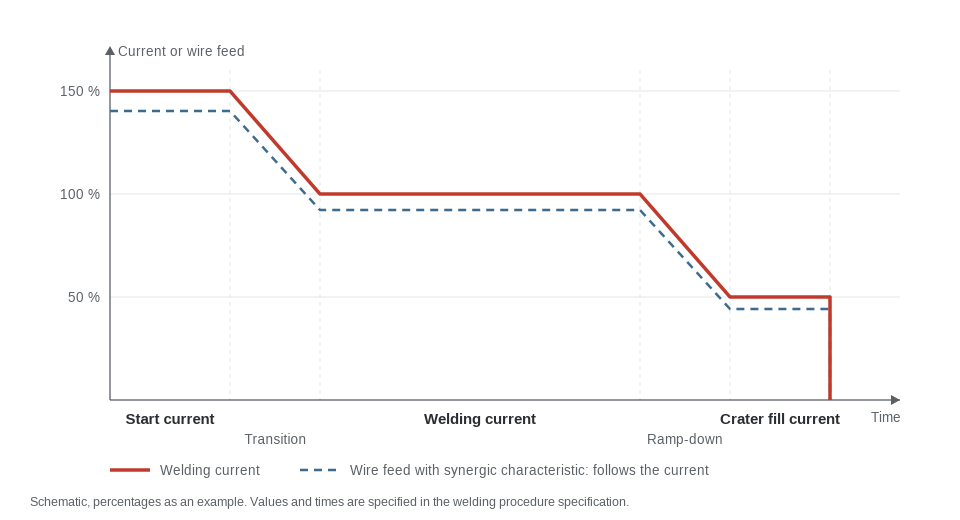
A typical programme starts at about 150 % of the welding current, changes to 100 % after a short time and ends at about 50 % to fill the crater. The exact values and times belong in the welding procedure specification and are tested on the component. EN 1011-4 explicitly names the crater fill programme as a remedy against crater cracks.
The limit in MIG welding: with synergic characteristics, the wire feed is tied to the current. More power at the weld start also means more wire, less power at the weld end less wire. What would be needed is exactly the opposite: plenty of heat with little wire at the start, enough wire to fill with little heat at the end. That is why lack of fusion at the start, porosity and crater cracks cannot be reliably avoided with current programmes alone.
Which additional measures help?
Anything that keeps the weld start and end crater out of the component or evens out the heat conditions. Where the design allows, run-on and run-off plates are the most reliable solution.
| Measure | Effect |
|---|---|
| Run-on and run-off plates | ignition and end crater lie outside the weld and are cut off afterwards; EN 1011-4 recommends placing the end crater on the run-off plate |
| Starting and finishing in the base metal | where no run-off plate is possible, for example ignite in the groove ahead of the actual weld start and lead the end crater back onto metal already welded |
| Running the weld out into the base metal | at the end, draw the weld a few millimetres beyond the groove into the base metal, so that the end crater lies outside the load-bearing weld cross-section |
| Preheating | evens out the temperature difference between start and end and improves fusion at the weld start |
| Cooled welding fixtures | keep the heat even and prevent it from running further and further ahead towards the end of the weld |
| Fewer interruptions | every interruption creates a new start and a new crater; mechanised longitudinal and circumferential welds without stopping largely avoid the problem |
When and how hot to preheat is covered under Preheating and interpass temperature. Where tack welds belong is described under Joint preparation.
How do you fill the end crater manually?
Do not simply break off the arc. At the end of the weld, stop travelling briefly and fill the crater before it solidifies, then end the arc.
- TIG with remote or foot control: reduce the current slowly while adding filler metal until the pool solidifies.
- Without current reduction: at the end, quickly lead the arc back a short way onto the finished weld while speeding up, so that the weld tapers off over a short distance and the crater stays small.
- Mechanised: programme wire feed, current and voltage so that the crater is filled on stopping and the values are gradually reduced.
This is also how the AWS Welding Handbook describes it. A crater crack cannot be repaired afterwards by welding over it: it must be ground or milled out and rewelded.
How cracks can be avoided in general and which filler metal reduces the cracking tendency is shown under Weld defects and how to avoid them.
Frequently asked questions
What is a crater crack?
A solidification crack in the crater at the end of the weld. It occurs when the arc goes out abruptly and the pool solidifies without being fed. Aluminium is particularly susceptible because of its high solidification shrinkage.
How do you set a crater fill programme?
A crater fill current of about half the welding current can serve as a starting point. The exact values and times depend on material, thickness and weld shape; they are determined on test welds and recorded in the welding procedure specification.
Why does the weld show lack of fusion at the start even though the start current is increased?
In MIG welding the wire feed rises together with the current. Part of the additional heat then goes into the additional wire instead of into the base metal. Run-on plates or preheating help more here.
Further reading: articles on welding aluminium
The series follows the order of fabrication, from surface preparation to the finished weld. For an overview, see Welding aluminium: what is different from steel.

About the author
Robert Lahnsteiner, Ing., is an International Welding Engineer (IWE) and managing director of MIGAL.CO GmbH. After training in telecommunications and electronics at HTL Braunau, he spent eighteen years in welding technology at Fronius from 1983. Since 2001 he has run MIGAL.CO, the aluminium welding wire manufacturer in Landau an der Isar, together with Martin Erl. His focus is aluminium filler metals, wire manufacturing and wire feeding, and the monitoring of welding processes. Within DVS, the German Welding Society, he has served for around 30 years on technical committee FA03 “Arc welding” and chairs working group 2.4.4 “MIG welding of aluminium”.