


Does aluminium have to be cleaned before welding?
Yes, if low-porosity, strong and consistent welds are required. The surface plays a far larger role with aluminium than with steel, because grease, moisture and oxide carry hydrogen and foreign matter straight into the weld pool. Cleaning must therefore follow proven, defined and repeatable procedures.
The sequence is always the same: store correctly, degrease, remove the oxide layer and then weld promptly. Brushing first and degreasing afterwards works the grease into the surface.
A research project on reproducibility in MIG welding of aluminium (AiF 12.239 N, ISF Aachen, University of Hannover and IfS Braunschweig) shows what the individual steps achieve:
- Careful removal of grease and oil at the joint reduced porosity in all tests.
- Removing the oxide immediately before welding did not reduce porosity in every case, but made the results more consistent: tensile strength scattered by ± 1.8 N/mm² for brushed specimens and by ± 6.6 N/mm² for untreated ones.
- Milled joint edges consistently gave better welds than guillotine-sheared edges, because no uneven air gap lets air reach the root.
- Even felt-tip marker lines and fingerprints on the joint disturbed the process.
How should sheets, profiles and welding wire be stored?
Under cover, heated if possible and at a constant temperature. Temperature changes lead to condensation, and with aluminium that is one of the most frequent causes of porosity.
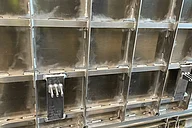
- Sheets and profiles should be stored upright and spaced apart so that air can circulate and no contact points form. Controlled humidity is desirable.
- Filler metals should be stored in a heated room at a constant temperature, protected from dust and contamination.
- Before processing, store base metal and wire in the same environment for at least 24 hours, the wire in its unopened original packaging. This way both reach the production temperature.
When condensation forms and how to avoid it is explained under Condensation.
How do you degrease aluminium before welding?
With a grease-dissolving cleaning agent such as acetone or alcohol and a clean, lint-free cloth, in the area of the joint and the adjacent surfaces. After that, handle the parts only with clean gloves.
Chlorinated solvents do not belong at the welding workplace: under the UV radiation of the arc, toxic gases form from their vapours. The cleaning agent must have evaporated completely before the arc is struck.
In series production, for example in car body manufacturing, joints are also cleaned without liquid chemicals. Methods described include CO₂ snow blasting, which partially removes drawing oil and dry lubricant, and hot active plasma, after which significantly fewer pores occurred on oiled sheets. In laser welding, laser cleaning of the sheets reduced porosity to below 1 %.
How do you remove the oxide layer?
Mechanically with a stainless steel brush, by scraping or milling, and in series production also chemically by pickling. What matters is that as little time as possible passes between oxide removal and welding, because the oxide layer starts growing again immediately.
| Method | What matters |
|---|---|
| Brushing | stainless steel brush with light pressure; too much pressure pushes oxide and dirt into the soft surface. With multi-pass welds, brush every pass. |
| Milling and scraping | removes oxide together with the surface layer by cutting, without abrasive residues; for bevels and joint preparation, use a milling ring on an angle grinder |
| Grinding | avoid if possible: abrasive grit and binder can become embedded in the soft aluminium and then end up in the weld |
| Blasting | only with clean, iron-free blasting media; the effect on porosity is limited |
| Pickling | for series production and large areas; rinse and dry thoroughly afterwards, otherwise residues and hydrated layers become new sources of hydrogen |
Tools for aluminium stay with aluminium. Brushes, files or abrasives previously used on steel carry in iron particles, which can later trigger pitting corrosion.
MIGAL.CO milling rings remove aluminium by cutting on an angle grinder, for bevelling weld edges, levelling welds and opening up the root. No grinding dust is produced and no abrasive residues remain in the material. More under Milling replaces grinding: Milling rings and Double-sided milling rings.
Video: milling rings in use.
Does the welding wire also have to be cleaned?
Not in production, and you should not try to. The wire surface is created by the manufacturer and must come out clean, uniform and with a thin oxide layer there. For the user, what matters is to preserve this condition until welding.
MIGAL.CO shaves its aluminium wire: the surface is removed together with the oxide and re-forms under defined conditions. The wire is packed gas-tight under vacuum in aluminium composite foil. Why this matters is explained under Oxide layer. All wires with data sheets: Aluminium welding wire.
Frequently asked questions
What do you clean aluminium with before welding?
First degrease with acetone or alcohol, then remove the oxide layer with a stainless steel brush, by scraping or by milling. Do not use chlorinated solvents at the welding workplace.
Why not an ordinary steel brush?
Brushes made of carbon steel, or tools already used on steel, leave iron particles on the aluminium. These can trigger corrosion. For aluminium, use only stainless steel brushes reserved exclusively for aluminium.
How long before welding must the oxide be removed?
As shortly as possible. The oxide layer forms again immediately and thickens over time, especially in humid air. Parts that lie around for a long time after brushing should be prepared again before welding.
Is it enough just to brush aluminium?
No. If the surface is greasy, the brush spreads the grease and works it in. For porosity, degreasing before brushing is actually the more important step.
Further reading: articles on welding aluminium
The series follows the order of fabrication, from surface preparation to the finished weld. For an overview, see Welding aluminium: what is different from steel.

About the author
Robert Lahnsteiner, Ing., is an International Welding Engineer (IWE) and managing director of MIGAL.CO GmbH. After training in telecommunications and electronics at HTL Braunau, he spent eighteen years in welding technology at Fronius from 1983. Since 2001 he has run MIGAL.CO, the aluminium welding wire manufacturer in Landau an der Isar, together with Martin Erl. His focus is aluminium filler metals, wire manufacturing and wire feeding, and the monitoring of welding processes. Within DVS, the German Welding Society, he has served for around 30 years on technical committee FA03 “Arc welding” and chairs working group 2.4.4 “MIG welding of aluminium”.