





Why is aluminium wire harder to feed than steel wire?
Because it is soft and buckles easily. Wire feed systems were developed for steel wire, which is stiff and slides well. Aluminium wire has a much lower buckling stiffness, deforms under the pressure of the feed rolls and is shaved off at every sharp edge.
Pure aluminium and the AlSi wires are the most difficult, because they are softer than the AlMg wires. Yet a constant wire speed is one of the most important variables in MIG welding. If it fluctuates, arc length, penetration and weld shape fluctuate too. In the research project AiF 12.239 N, roll pressure, brake, contamination and routing of the hose package had a “decisive influence” on the result. After every change to the feed system, the process had to be set up again.
Why must aluminium wire not be pulled through a liner?
Because the friction reinforces itself. A pulled wire presses against the inside of the hose in every bend. The harder you pull, the more firmly it presses, and the force grows exponentially with the sum of all bends.
This is described by the Euler-Eytelwein capstan equation. The following table shows by what factor the required pulling force increases. For a new liner, MIGAL.CO works with a coefficient of friction of about 0.2. ISF Aachen measured values of 0.05 to 0.07 in the laboratory for aluminium wire against feed liners. The table shows both cases.
| Sum of all bends | µ = 0.07 | µ = 0.2 |
|---|---|---|
| 90° (quarter circle) | 1.1 times | 1.4 times |
| 360° (one loop) | 1.6 times | 3.5 times |
| 720° | 2.4 times | 12 times |
| 1080° | 3.7 times | 43 times |
Calculated according to Euler-Eytelwein, F₂ = F₁ · eµ·α. µ = 0.07: laboratory value from ISF (IGF 17.524 N); µ = 0.2: MIGAL.CO experience value for a new liner.
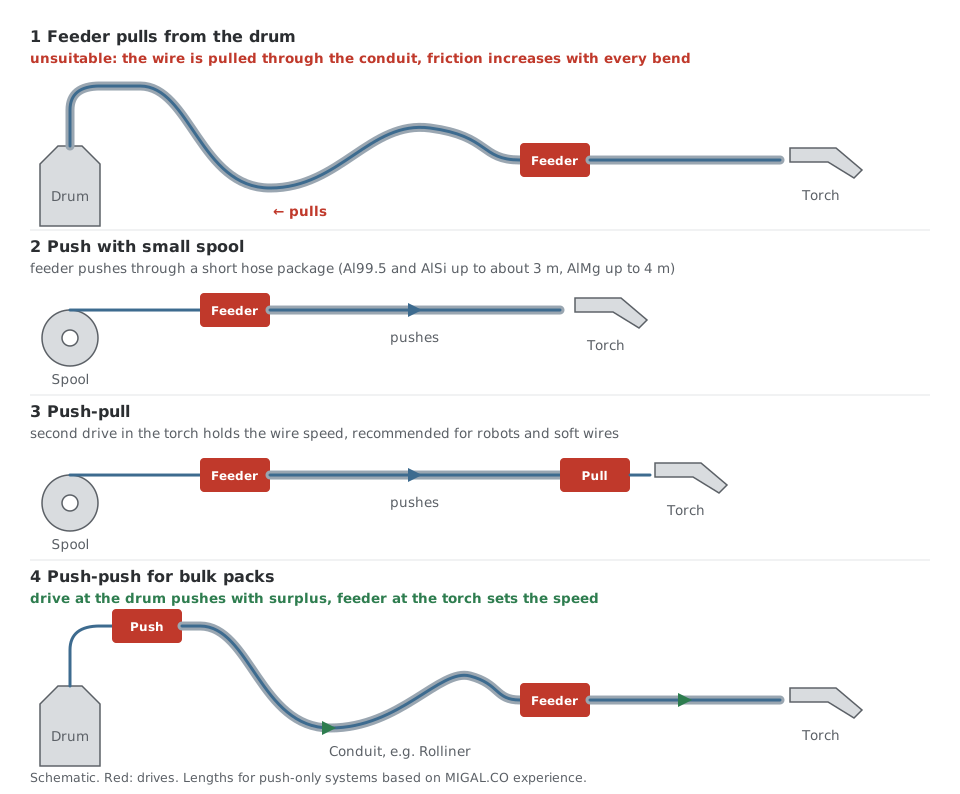
With a small spool this hardly matters, because the feeder sits right next to it. With drums and large spools, however, the feeder often pulls the wire through a long conduit. That is exactly what goes wrong with aluminium: the wire drags, the speed fluctuates, and in the extreme case it jams.
Which wire feed system is suitable for aluminium?
One in which the wire is only pushed over short distances and never pulled through a long hose. The softer the wire and the longer the path, the more likely you need a second drive.
| System | Use |
|---|---|
| Push, small spool | manual welding with a short hose package: for Al99.5 and AlSi no more than about 3 m, for AlMg up to 4 m |
| Push-pull | second drive in the torch; for soft wires, longer hose packages and for robots and automated systems, there with hose packages of 1.5 to 2 m |
| Push-push | for drums and large spools: a drive at the pack pushes the wire with surplus into the conduit, the feeder at the torch sets the speed |
How important the second drive can be is shown by AiF 12.239 N: with a push-pull torch, operating with the rear drive only no longer produced usable welds. A hose package bent by up to about 180°, by contrast, had no effect on the weld in the same trial.
What matters with feed rolls, liner and contact tip?
Gentle guidance along the whole path. The wire must not rub, be deformed or buckle anywhere. The equipment follows the equipment manufacturer’s specifications for aluminium.
- Feed rolls: rolls with a smooth, rounded groove for aluminium, ideally a four-roll drive. Set the pressure only as high as necessary. Too little pressure makes the wire speed fluctuate, too much deforms the wire.
- Liner: a plastic liner instead of a steel spiral, guided without a gap as close as possible to the rolls and contact tip, so that the wire cannot buckle. Replace worn or dirty liners.
- Contact tip: larger bore than for steel; 1.6 mm for 1.2 mm wire, for example, has proven itself. The contact tip is a wear part and should be checked regularly.
In the project AiF 12.239 N, the contact tips lasted between 1 and 100 welding trials, without any advance warning of their end. The cause was aluminium deposits that narrowed the bore and jammed the wire. Wire deformed by excessive roll pressure promotes such deposits. A study on wire surfaces (Der Praktiker, 2023) also sees the cause of many feeding problems in the current transfer in the contact tip.
Some of the problems arise before the torch. Loose particles and residues from the wire surface collect in the liner and contact tip. A smooth, clean surface is therefore also important for feeding. How MIGAL.CO shaves and packs its wire for this is described under Oxide layer.
How do you feed aluminium wire from a drum?
With a short, straight connection to the feeder and, over longer distances, with a low-friction conduit or an additional drive. Drums provide a lot of wire without changing spools, but they need a well-planned feed path.
The wire is drawn upwards out of the drum; the drum does not rotate. This twists the wire. Depending on the material it can suddenly tangle; wires made of AlMg alloys are particularly prone to this. Drum hoods and decoiling aids guide the wire as it is drawn off.
- Route it short and without loops. Every bend increases friction, see the table above.
- Rollers instead of sliding friction: in the Rolliner 3G, Rolliner NG and Rolliner XL2, the wire runs only over pairs of rollers, each offset by 90°.
- Additional drive: the pneumatic feed assist DLDA1 compensates for the friction in the conduit. RoboFeed pushes the wire as a second drive to the robot, even over feed distances of more than 50 m.
MIGAL.CO’s ECO-drums and Jumbo drums do not need a separate decoiling device. Dimensions and weights are listed under Drum dimensions, all accessories under Wire transport. We are happy to advise on designing the feed path.
Video: Rolliner 3G, the wire conduit with rollers for less friction.
Frequently asked questions
How long may the hose package be when welding aluminium?
In push-only operation, no more than about 3 m for Al99.5 and AlSi, up to 4 m for the stiffer AlMg wires. Longer hose packages need a push-pull torch. On robots and automated systems, 1.5 to 2 m has proven itself.
Which contact tip for aluminium wire?
One with a larger bore than for steel wire of the same diameter, for example 1.6 mm for 1.2 mm wire. Deposits in the bore are the most common cause of sudden feeding faults.
Why does the aluminium wire stutter?
Common causes are a worn or narrowed contact tip, a dirty or wrong liner, too much or too little roll pressure, tight bends in the hose package and too long a path without a second drive.
Is AlMg or AlSi wire easier to feed?
AlMg wire is stiffer and easier to feed. AlSi wire and pure aluminium are softer and need shorter paths or a second drive. In the drum, on the other hand, AlMg wires are more prone to tangling.
Further reading: articles on welding aluminium
The series follows the order of fabrication, from surface preparation to the finished weld. For an overview, see Welding aluminium: what is different from steel.

About the author
Robert Lahnsteiner, Ing., is an International Welding Engineer (IWE) and managing director of MIGAL.CO GmbH. After training in telecommunications and electronics at HTL Braunau, he spent eighteen years in welding technology at Fronius from 1983. Since 2001 he has run MIGAL.CO, the aluminium welding wire manufacturer in Landau an der Isar, together with Martin Erl. His focus is aluminium filler metals, wire manufacturing and wire feeding, and the monitoring of welding processes. Within DVS, the German Welding Society, he has served for around 30 years on technical committee FA03 “Arc welding” and chairs working group 2.4.4 “MIG welding of aluminium”.