





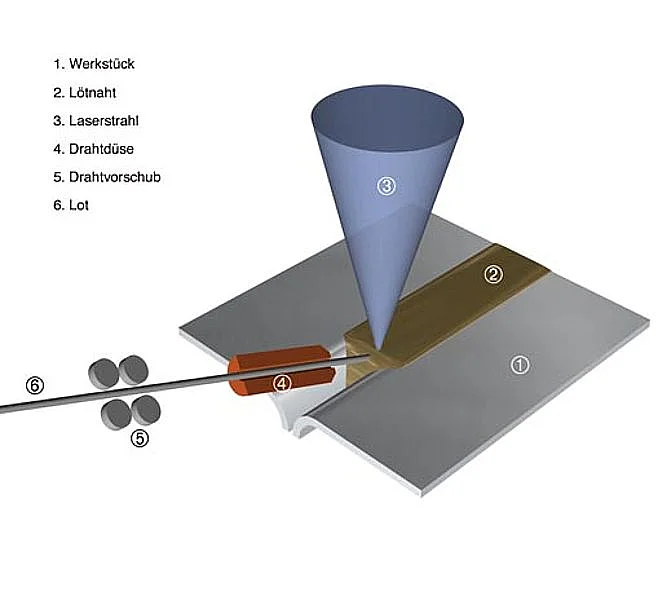
What is laser beam brazing?
In laser beam brazing, a laser melts the filler wire, usually CuSi3; as in arc brazing, the steel stays solid. There is no arc, only a precisely placed focal spot. This produces very smooth seams at several metres per minute and little distortion.
Under ISO 4063, laser beam brazing, number 976, is a process in its own right alongside arc brazing (972). It belongs in this series because the filler metal, base material and seam shape are the same: galvanised sheet steel, copper-based filler metal, flange or fillet seam.
It is used mainly in high-volume car body production, for example on the roof and tailgate. There the seams are considered suitable for the outer skin: they are painted without significant rework and remain visible. If the wire is additionally heated electrically, this is called laser hot-wire brazing. It increases the speed further.
What does the laser offer compared with the arc?
Higher speed, less heat and a seam surface that can be painted without grinding. The price is high equipment costs, tight gap tolerances and an enclosed laser safety cell.
- Surface: the focal spot is small and uniform, the seam smooth. Spatter as in MIG brazing hardly occurs.
- Heat: the energy goes specifically into the filler metal. Distortion remains low, even on long outer skin seams.
- Limits: the laser needs precisely positioned components and precise wire feeding. For single parts, repairs or seams with a varying gap, MIG brazing remains more economical.
Why is hot-dip galvanised sheet more difficult in laser brazing?
The surface of hot-dip galvanised sheet is less even than that of electrogalvanised sheet. With a single focal spot, the seams then become rougher and spatter. The remedy is optics with leading focal spots that clean the joint zone ahead of the filler metal.
In trifocal brazing, two small focal spots with high power density run ahead of the main spot. They vaporise dirt, oxides and part of the zinc layer and preheat the sheet. The main spot then melts the filler metal. The result is smooth seams with a clean edge, which are processed further without rework, and a larger bonding cross-section (Kessler, DVS-Berichte 327, 2016).
The leading spots can also be switched off on one side. In this way a steel-plastic composite sheet was brazed to galvanised sheet at 3 m/min without melting the plastic core.
What is laser-MIG hybrid brazing?
A laser and a MIG arc work in the same pool. The laser provides speed and a stable arc root position, the arc provides filler metal in large quantities and good gap bridging.
DVS 0938-1 lists laser-MIG brazing, together with plasma-MIG brazing, as a process combination that is being trialled. Both aim to combine the strengths of two heat sources. The plasma-MIG variant is described on the page TIG and plasma brazing.
MIG-TIG hybrid brazing: two arcs in one pool
A MIG arc supplies the filler metal, a trailing TIG arc smooths the seam. In trials by Weis and co-authors, this increased the brazing speed by more than 150 %, with less heat in the sheet and almost no spatter.
The two arcs burn only 6 mm apart and influence each other through their magnetic fields. To make them work together stably, the MIG current is specifically modulated, in the trial as MIG AC pulse. Lap joints of DX51D+Z with a thickness of 1 mm were brazed, with 1.0 mm CuSi3 under argon and the TIG arc at 90 A direct current.
| MIG brazing alone | MIG-TIG hybrid brazing | |
|---|---|---|
| Brazing speed | 30 cm/min | 77.5 cm/min |
| Heat input per unit length | 2.04 kJ/cm | 1.66 kJ/cm |
| Wetting angle | about 80° | about 20° |
| Seam cross-section | reference | about 60 % smaller |
| Spatter | increased | almost none |
| Zinc burn-off on the reverse side | greater | less |
Values according to Weis, Grunert, Brumm and Prank, DVS-Berichte 382 (2022), Table 3: MIG AC pulse with 2.9 m/min wire feed speed, alone and with a trailing TIG arc.
Despite the second heat source, the heat input per unit length fell because the seam ran so much faster. The seams were best when the TIG arc supplied about half of the total power. Too much TIG current burnt off the zinc layer on the reverse side and melted the sheet. All tensile specimens failed in the base material, so the seam withstood more than the 385 MPa of the sheet.
With a normal MIG pulse instead of AC pulse, the process was also reliable, with slightly more micro-spatter, but significantly less than with MIG brazing alone. The process needs two software-controlled power sources and so far is mainly a topic for mechanised production.
Which filler metal for laser and hybrid brazing?
CuSi3Mn1 is the standard filler metal for galvanised sheet here too. Because laser and hybrid processes run fast, uniform wire is particularly important.
Diameter, cast and helix must be closely toleranced, the surface smooth and clean. At several metres per minute, even small variations shift the position of the wire relative to the focal spot. More on this under Wire feeding and Filler metals and standard designations.
- ML CuSi3: standard filler metal for galvanised steel sheet
- all copper wires: Copper welding and brazing wire
Frequently asked questions
Is laser brazing the same as laser welding?
No. In laser welding the sheet melts, in laser brazing only the filler wire. Brazing uses a significantly lower power density and a larger focal spot.
Where is laser brazing used?
Mainly in high-volume car body production, on outer skin seams such as the roof and tailgate, which are painted without rework.
Is hybrid brazing worthwhile for small batches?
Usually not. Hybrid processes need two matched heat sources and mechanised guidance. For single parts and repairs, MIG brazing is the practical choice.
Is a laser-brazed or hybrid-brazed seam as strong as a MIG-brazed one?
In the hybrid trial by Weis and co-authors (2022), all tensile specimens failed in the base material, whether brazed with one process or hybrid. So the seam was not the weak point.
Further reading: articles on arc brazing
The series in the order in which the questions arise in practice: from the process via filler metal, gas and base material to the finished seam. For an overview, see Arc brazing.

About the author
Robert Lahnsteiner, Ing., is an International Welding Engineer (IWE) and managing director of MIGAL.CO GmbH. After training in telecommunications and electronics at HTL Braunau, he spent eighteen years in welding technology at Fronius from 1983. Since 2001 he has run MIGAL.CO, the aluminium welding wire manufacturer in Landau an der Isar, together with Martin Erl. His focus is aluminium filler metals, wire manufacturing and wire feeding, and the monitoring of welding processes. Within DVS, the German Welding Society, he has served for around 30 years on technical committee FA03 “Arc welding” and chairs working group 2.4.4 “MIG welding of aluminium”.