


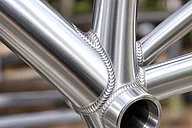
Arc brazing joins thin, galvanised steel sheet with a copper-based wire without melting the steel. This largely preserves the zinc protection beside the seam. This series explains processes, filler metals, gases and materials and shows how to achieve good seams, avoid defects and test the seam.
The series is based mainly on the technical bulletins DVS 0938-1 to 0938-3 of DVS, the German Welding Society, on ISO 24373 and on DVS research reports. Robert Lahnsteiner has worked for around 30 years on DVS technical committee FA03 “Arc welding”, where he has been deputy chairman for many years. He chairs working group 2.4.4 “MIG welding of aluminium”, was active in working group 2.4.8 “Arc brazing” and contributed to the DVS technical bulletins 0938-1 and 0938-2 on which this series is based.
A good place to start is Brazing or welding?. The other articles follow the questions as they arise in practice and can also be read individually.
Basics: when to braze, which process?
- Brazing or welding?: What distinguishes brazing from MAG welding, why it is gentle on thin galvanised sheet and where its limits lie.
- Processes at a glance: MIG, TIG and plasma brazing compared, process numbers to ISO 4063 and how to specify them on the drawing.
Processes: equipment, settings, technique
- MIG brazing: Guide values for short arc and pulsed arc, power source, torch position.
- TIG and plasma brazing: Equipment, settings and variants such as hot wire and plasma-MIG.
- Laser and hybrid brazing: Laser beam brazing, laser-MIG and MIG-TIG hybrid with measured values from research.
Materials: filler metal, gas, sheet, wire
- Filler metals and standard designations: CuSi3, CuAl8 and tin bronzes, designation to ISO 24373 and old DIN and AWS names.
- Shielding gas: Argon, mixed gas or argon-helium to suit the filler metal, and where pores come from.
- Base materials and coatings: Galvanised and aluminised sheet, zinc layer thickness, corrosion beside the seam, higher-strength steels and stainless steel.
- Wire feeding: Feeding copper wire without problems: liner, feed rolls, push-pull, cast and helix.
Result: seam, defects, testing
- Joint types and seam geometry: Lap joint, flange seam, gap sizes and design rules.
- Seam defects and braze cracking: Pores, spatter, lack of bonding and cracks: causes and remedies.
- Testing, rework, health and safety: Test methods, assessment, re-brazing and the rules for fumes, dust and eye protection.
Brazing wire and accessories
- Copper welding and brazing wire: CuSi3, CuAl8 and tin bronzes with data sheets.
- Wire transport: wire feed conduits, payoff aids and auxiliary drives for long distances.
Frequently asked questions
What is arc brazing?
A joining process using almost the same equipment as MIG/MAG welding. The copper-based filler metal melts at around 1,000 °C, the steel only at around 1,500 °C. The base material stays solid; the liquid filler metal merely wets it.
When is brazing worthwhile instead of welding?
For galvanised or otherwise coated sheet up to about 3 mm, when the corrosion protection is to be preserved and the strength of the filler metal is sufficient. For thick or high-strength parts and high service temperatures, welding is the better choice.
Which filler metal should be used?
For galvanised sheet usually CuSi3, the standard filler metal. CuAl8 for aluminised sheet and when higher strength is needed.

About the author
Robert Lahnsteiner, Ing., is an International Welding Engineer (IWE) and managing director of MIGAL.CO GmbH. After training in telecommunications and electronics at HTL Braunau, he spent eighteen years in welding technology at Fronius from 1983. Since 2001 he has run MIGAL.CO, the aluminium welding wire manufacturer in Landau an der Isar, together with Martin Erl. His focus is aluminium filler metals, wire manufacturing and wire feeding, and the monitoring of welding processes. Within DVS, the German Welding Society, he has served for around 30 years on technical committee FA03 “Arc welding” and chairs working group 2.4.4 “MIG welding of aluminium”.