





What is arc brazing?
In arc brazing, an arc joins thin steel sheets with a copper-based wire, usually CuSi3Mn1 or CuAl8. The filler metal melts at around 1000 °C, the steel only at around 1500 °C. The base material therefore remains solid; the liquid filler metal merely wets it. The equipment is almost the same as for MIG/MAG welding.
The most common form is MIG brazing (GMA brazing): the copper-based wire is fed through the hose package like a welding wire and melts in the arc. There are also TIG and plasma brazing, in which the wire runs into the arc without current, and laser beam brazing as a related process. None of these processes needs a flux, because the arc cleans and activates the surface itself.
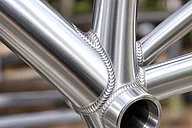
Physically, it is brazing: the joint is formed by wetting and diffusion at the interface, not by a common weld pool. Unlike furnace or flame brazing, however, there is hardly any capillary action. The filler metal does not fill a narrow gap but forms a seam as in welding, usually a fillet seam on a lap joint. Joint preparation is generally not necessary.
Which processes exist and how they differ is shown in Processes at a glance.
Why braze galvanised sheet instead of welding it?
Because zinc melts at 419 °C and evaporates at 907 °C, far below the melting temperature of the steel. In welding, the zinc evaporates over a wide area; the vapour disturbs the arc and causes pores and spatter. In brazing, the temperature stays lower and the zinc layer is damaged only on a narrow strip.
Next to a brazed seam on galvanised sheet, DVS 0938-1 describes two zones: directly at the seam a zinc-free zone in which the zinc has evaporated, and next to it a dark zone in which it has only melted and solidified again. With good settings, only the dark zone forms on the reverse side of the sheet. The zinc layer remains closed there and continues to protect.
This results in the well-known advantages:
- The corrosion protection layer is largely preserved, also on the reverse side and in cavities where re-protection is not possible.
- Hardly any spatter and pores from zinc vapour, less rework.
- Low heat input, therefore little distortion and hardly any burn-through on thin sheet.
- The brazed seam itself does not corrode like steel, because it consists of a copper alloy.
- Good gap bridging, especially with the pulsed arc.
According to DVS 0938-1, sheets with zinc coatings up to 15 µm can generally be brazed without problems. Thicker layers, for example on batch-galvanised parts, require separate trials. More on this under Base materials and coatings.
Brazing or MAG welding: the direct comparison
| Feature | Arc brazing (MIG brazing) | MAG welding |
|---|---|---|
| Filler material | copper-based wire, e.g. CuSi3Mn1 or CuAl8 | steel wire, e.g. G3Si1 |
| Melting temperature of the filler | around 900 to 1070 °C | around 1500 °C |
| Base material | is not melted, or only slightly | is melted |
| Zinc layer next to the seam | narrow zone, reverse side remains largely protected | evaporated over a wide area, re-protection needed |
| Spatter, pores from zinc vapour | little | considerably more |
| Distortion | low | greater |
| Strength of the seam | limited by the filler metal, tensile strength over 340 MPa (CuSi3Mn1) | matches the steel |
| Sheet thickness | up to about 3 mm | no such limit |
| Seam colour | copper to gold coloured | like the steel |
Guide values. Melting ranges and strength of the filler metals according to DVS 0938-1, Table 5 (manufacturer data for the pure braze metal). How much the zinc layer suffers depends mainly on the settings.
Where are the limits of arc brazing?
Strength, temperature and sheet thickness. The filler metal is softer than high-strength steels, copper-based filler metals creep at higher service temperatures, and the process is intended for sheet up to about 3 mm. Formed areas under tensile stress are prone to braze cracking.
- Strength: in the pure braze metal, CuSi3Mn1 achieves a yield strength over 200 MPa and a tensile strength over 340 MPa, CuAl7 (formerly CuAl8) over 380 MPa. For soft deep-drawing steels this is sufficient; in the tensile shear test it is then the sheet that fails, not the seam. With higher-strength steels, the filler metal is the weakest link. DVS 0938-2 already shows a borderline case with H260LA and 1 mm that must be tested.
- Service temperature: according to DVS 0938-1, the creep resistance of copper-based filler metals is given up to about 250 °C; above that they can creep. The older DVS technical bulletin 0938-2 does not yet recommend arc brazing above 180 °C. Copper-based filler metals are resistant to oxidation up to about 450 °C. For low temperatures, on the other hand, there is no limit; copper materials do not become brittle.
- Sheet thickness: both DVS technical bulletins apply to sheet up to 3 mm. Above that, brazing loses its advantage; the heat required damages the coating anyway.
- Braze cracking: under tensile stress, liquid filler metal can penetrate the steel along the grain boundaries (liquid metal embrittlement). The rule is therefore: do not braze on formed contours under tensile stress, and let the seam shrink freely. For austenitic CrNi steels with residual stresses, DVS 0938-2 advises against arc brazing. More under Seam defects and braze cracking.
- Appearance: the seam is copper to gold coloured. On visible surfaces of stainless steel or unpainted steel, this stands out.
A brazed seam must never be welded over, not even after grinding. Copper in the weld pool of the steel leads to embrittlement and cracks (DVS 0938-2). Rework is done only with the same filler metal.
Where is arc brazing used?
Wherever thin, galvanised sheets are joined permanently and the corrosion protection is to be preserved: in car body construction, in ventilation and air-conditioning technology, in control cabinet and container construction, on railings, fences and façades, in heating and exhaust systems and in shipbuilding.
- Vehicle construction: this is where the process began, and this is where most applications still lie today. DVS 0938-2 shows an automated plasma-brazed car body roof made of 0.8 mm galvanised DC05 with CuSi3. Visible seams on the outer skin are often laser brazed today, see Laser and hybrid brazing.
- Exhaust systems: a silencer made of the ferritic stainless steel 1.4510 with a wall thickness of 0.4 to 0.8 mm is MIG brazed in automated production, with CuAl5Ni2 under argon (example from DVS 0938-2).
- Shipbuilding: at the University of Rostock, galvanised seawater pipelines with lap sleeves were MIG brazed instead of welded. Re-protection was no longer needed, the zinc layer inside the pipe showed no anomalies in the corrosion test, and production costs fell by around 30 % (Wanner, Henkel, Anders, Hein, DVS-Berichte 275, 2011).
- Ventilation, buildings, furniture: ventilation ducts, conservatories, railings, control cabinets and furniture frames made of galvanised sheet or tube. Where the seam remains visible, CuAl8 is often chosen because its golden colour looks more even.
Brazing or welding? A decision aid
Brazing pays off when galvanised or otherwise coated sheets up to about 3 mm are joined, the corrosion protection is to be preserved and the strength of the filler metal is sufficient. Welding is the better choice for thick or high-strength parts, high service temperatures and wherever the seam must be as strong as the steel.
Prefer brazing
- galvanised, aluminised or otherwise metallic-coated thin sheet
- sheet thickness up to about 3 mm, fillet seam on a lap joint, flange seam
- reverse side or cavity cannot be re-protected
- little distortion and little spatter required
- service temperature up to about 180 °C, with verification up to about 250 °C
Prefer welding
- sheets and sections over 3 mm, hot-dip galvanised parts with a thick zinc layer
- high-strength steels where the seam must reach the strength of the sheet
- permanently high service temperatures
- seam is to be the same colour and inconspicuous, without painting
In case of doubt, a trial on the original component decides: tensile shear, peel or bend tests show whether the sheet or the seam fails. According to DVS 0938-2, a brazed joint is suitable if the fracture lies in the base material and not in the seam.
Which brazing wire is suitable?
For galvanised sheet, CuSi3Mn1 is the standard and the most widely used in Germany. CuAl8 is used for aluminised sheet, for stainless steel and when the seam remains visible. Both are usually used in 1.0 mm.
- ML CuSi3: copper-silicon wire for galvanised steel sheet, also available as ML CuSi28L with the same composition.
- ML CuAl8: aluminium bronze for aluminised sheet, stainless steel and decorative seams.
All copper wires at a glance: Copper welding and brazing wire. How the filler metals are standardised and which is suitable for what is explained in Filler metals and standard designations.
Frequently asked questions
Is arc brazing brazing or soldering?
Brazing. The copper-based filler metals melt at around 900 to 1070 °C, far above the limit of 450 °C from which one speaks of brazing.
Do you need a flux for MIG brazing?
No. The arc cleans and activates the surface, and the shielding gas protects the liquid filler metal. The sheets must, however, be clean and free of oil, wax and adhesive.
Can I braze with my MIG/MAG machine?
Usually yes. The power source must, however, work stably in the lower range of about 25 to 100 A, and the soft copper wire needs a plastic liner and suitable feed rolls. Modern pulse machines offer their own characteristic curves for CuSi3 and CuAl8. More under MIG brazing and Wire feeding.
How strong is a brazed seam?
The pure braze metal of CuSi3Mn1 reaches a tensile strength of over 340 MPa. On soft deep-drawing sheet, it is usually the sheet next to the seam that tears in the tensile shear test. With higher-strength steels, suitability must be tested.
Can a brazed seam be welded later?
No. A brazed seam must not be welded over, not even after grinding, because the copper can embrittle the steel. Repairs are made with the same filler metal.
Further reading: articles on arc brazing
The series in the order in which the questions arise in practice: from the process via filler metal, gas and base material to the finished seam. For an overview, see Arc brazing.

About the author
Robert Lahnsteiner, Ing., is an International Welding Engineer (IWE) and managing director of MIGAL.CO GmbH. After training in telecommunications and electronics at HTL Braunau, he spent eighteen years in welding technology at Fronius from 1983. Since 2001 he has run MIGAL.CO, the aluminium welding wire manufacturer in Landau an der Isar, together with Martin Erl. His focus is aluminium filler metals, wire manufacturing and wire feeding, and the monitoring of welding processes. Within DVS, the German Welding Society, he has served for around 30 years on technical committee FA03 “Arc welding” and chairs working group 2.4.4 “MIG welding of aluminium”.